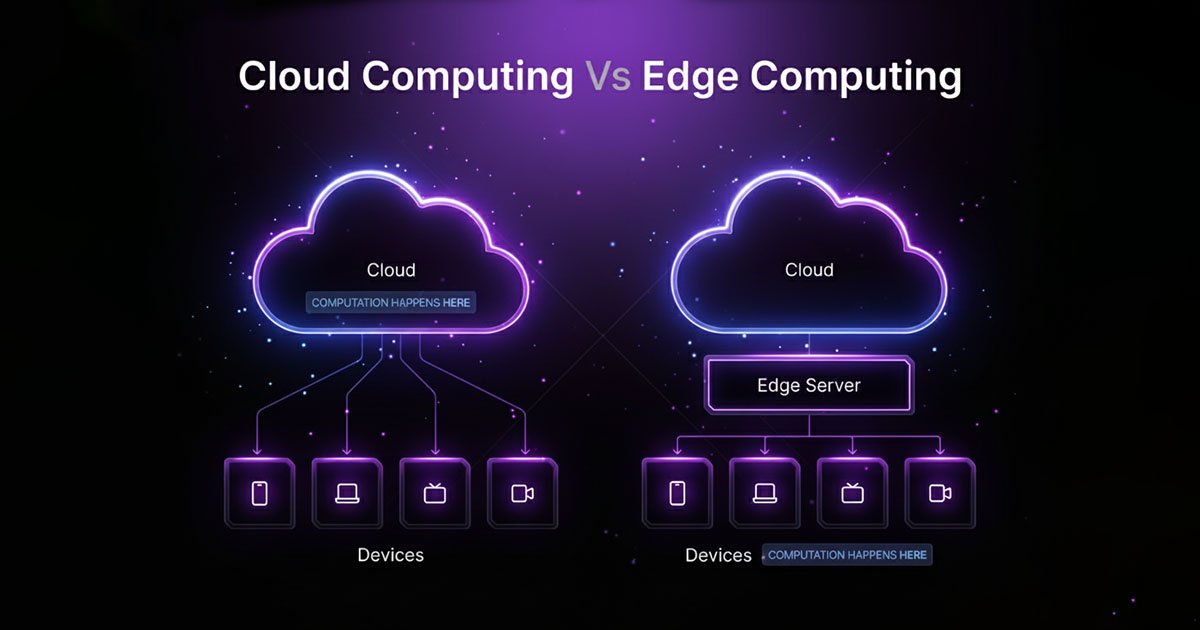

Cloud computing vs edge computing, their differences, use cases, advantages, and which one is right for your business. As digital transformation accelerates in 2025, businesses are processing more data than ever before. From real-time analytics and AI applications to IoT devices and remote operations, the way data is stored, processed, and delivered has become a critical strategic decision.
Two technologies dominate this conversation: Cloud Computing and Edge Computing.
While both play vital roles in modern IT infrastructure, they serve different purposes and solve different problems. Understanding the key differences between cloud computing and edge computing helps businesses choose the right approach—or the right combination—for performance, security, and scalability.
At Cloudex369 IT Solutions, we help organizations design, deploy, and secure both cloud and edge infrastructures tailored to their operational needs.
Table of Contents
ToggleWhat Is Cloud Computing?
Cloud computing refers to delivering computing services—such as servers, storage, databases, networking, software, and analytics—over the internet instead of on-premises infrastructure.
In this model, data is sent to centralized cloud data centers where it is processed and stored.
Key Characteristics of Cloud Computing
- Centralized data processing
- Scalable resources on demand
- Pay-as-you-go pricing
- Global accessibility
- Managed by cloud service providers
Common Cloud Services
- Cloud hosting (shared, VPS, dedicated)
- Software as a Service (SaaS)
- Platform as a Service (PaaS)
- Infrastructure as a Service (IaaS)
Cloudex369 provides secure, high-performance cloud hosting and managed cloud services that allow businesses to scale quickly without heavy infrastructure investments.
What Is Edge Computing?
Edge computing processes data closer to where it is generated—at the “edge” of the network—rather than sending it to a centralized cloud server.
This could be on:
- IoT devices
- Local servers
- Gateways
- On-site data centers
By reducing the distance data must travel, edge computing minimizes latency and enables real-time processing.
Key Characteristics of Edge Computing
- Decentralized data processing
- Ultra-low latency
- Faster decision-making
- Reduced bandwidth usage
- Localized data handling
Edge computing is particularly valuable for industries that require instant responses, such as healthcare, manufacturing, autonomous systems, and smart cities.
Cloud Computing vs Edge Computing: Core Differences
Let’s break down the main differences between the two technologies.
Data Processing Location
- Cloud Computing: Information is handled in centralized data centers.
- Edge Computing: Information is processed locally, close to the source.
Latency
- Cloud Computing: Higher latency due to data traveling to remote servers.
- Edge Computing: Extremely low latency with near-instant processing.
Scalability
- Cloud Computing: Highly scalable with virtually unlimited resources.
- Edge Computing: Limited by local hardware capacity.
Bandwidth Usage
- Cloud Computing: Requires continuous data transfer to the cloud.
- Edge Computing: Reduces bandwidth usage by processing data locally.
Reliability
- Cloud Computing: Depends on stable internet connectivity.
- Edge Computing: Can operate even with limited or no internet access.
- Cost Structure
- Cloud Computing: Subscription-based or pay-as-you-go.
Edge Computing: Higher upfront hardware cost but lower long-term data transfer expenses.
When Should You Use Cloud Computing?
Cloud computing is ideal when your business requires:
- Large-scale data storage
- Global accessibility
- Centralized management
- Cost-effective scalability
- Backup and disaster recovery
- AI model training and analytics
Common Cloud Use Cases
- Web and application hosting
- SaaS platforms
- Enterprise databases
- Collaboration tools
- Data backups and recovery
- Big data analytics
Cloudex369 helps businesses migrate to the cloud securely, optimize performance, and manage infrastructure with 99.9% uptime and enterprise-grade security.
When Should You Use Edge Computing?
Edge computing is best suited for scenarios where speed and real-time decision-making are critical.
Common Edge Use Cases
- IoT devices and sensors
- Smart manufacturing
- Healthcare monitoring systems
- Autonomous vehicles
- Smart surveillance
- Retail analytics
- Industrial automation
In such environments, waiting for data to travel to the cloud and back could cause delays, errors, or safety risks.
Security Considerations: Cloud vs Edge
Cloud Security
Cloud providers offer strong security features such as:
- Data encryption
- Firewalls
- Identity and access management (IAM)
- Compliance certifications
However, centralized systems can become high-value targets if not properly secured.
Edge Security
Edge computing reduces exposure by keeping sensitive data local, but it introduces challenges:
- More endpoints to secure
- Physical device vulnerabilities
- Patch and update management
At Cloudex369, we implement hybrid security models combining cloud-level protection with edge-level monitoring, encryption, and automated updates to ensure end-to-end security.
Cloud + Edge: The Hybrid Future
In 2025, the debate is no longer cloud vs edge. It’s cloud + edge.
Most modern businesses benefit from a hybrid architecture, where:
- Edge computing handles real-time data processing
- Cloud computing manages storage, analytics, and centralized control
Example:A smart factory uses edge devices to process machine data instantly while sending summarized insights to the cloud for long-term analytics and reporting.
Cloudex369 specializes in hybrid cloud-edge architectures, ensuring seamless integration, scalability, and security across environments.
How Cloudex369 Helps Businesses Choose the Right Model
Choosing the right infrastructure depends on your:
- Industry
- Data volume
- Performance needs
- Security requirements
- Budget
Cloudex369 provides:
- Cloud infrastructure design
- Edge computing consultation
- Secure hosting and server managemen
- AI-powered monitoring
- Hybrid architecture implementation
- Ongoing support and optimization
Our experts help you build future-ready IT systems that balance performance, cost, and security.
Conclusion: Which One Is Right for You?
Both cloud computing and edge computing play crucial roles in modern IT strategies.
- Choose Cloud Computing if you need scalability, centralized control, and global access.
- Choose Edge Computing if you need ultra-low latency, real-time processing, and localized decision-making.
- Choose a Hybrid Approach if you want the best of both worlds.
At Cloudex369 IT Solutions Pvt. Ltd., we help businesses harness cloud and edge technologies to drive innovation, efficiency, and growth securely and intelligently.



Great read! Cloud handles scale and storage, while edge delivers speed and real-time processing. Hybrid approaches clearly offer the best of both worlds for modern businesses.